"National Patrimony" and "Cultural Heritage" usually makes one think of things several hundred (or thousand, if you ask the archeologists) years old. After all, how can you inherit something that may be younger than you are. In addition, in the short history of nations and national patrimony, there has been literally so much stuff from pre-modern times that needed saving that newer patrimony was often thrown to the wayside.
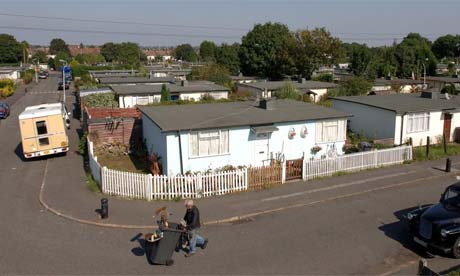
For that reason, it is particularly pleasing to see, that the British will be granting Grade II status to a postwar prefabricated housing project in south-east London. This has caused a lot of confusion in the British public, not only because the government is preserving something with age still in the double-digits, but because many people don't even consider them worth preserving. The prefab housing projects are, quite simply, ugly.
Of course, the job of cultural heritage preservers is to think beyond 'ugly'. It is because of their uglyness, that the prefab housing projects, authored often by visionary city planners like Le Corbusier or Berthold Lubetkin, have been torn down over the past few decades and replaced with more modern version of the middle-class suburbian ideal. The downside is that unless regulatory action is taken, an entire period of history will soon be forever lost in everything but pictures.
Of course, one may claim, that if anything, then erasing such ugly and ineffective buildings from history may well be in the best interests of society. Certainly the classical liberal types will argue that if market forces decide to tear down the prefabs, then they should be torn down. Unfortunately, market forces, as usually is the case, do not take into account the social and historical impact the prefab estates have had on people's minds, and the loss for human culture that their destruction causes, may only become apparent after the fact.

This has happened in many places across Eastern Europe,where Communist Architecture was often left in disarray after the collapse of the Soviet Union. The result is, that for instance in Estonia, only 9 buildings constructed in the 1960-s in the entire country have been declared cultural heritage and the rest have either been torn down or are on their way to demolition, very often accompanied by intense public resistance. The most famous example of this is probably the demolition of the Sakala Center in Tallinn in 2006 - a pinnacle of 1980-s soviet architecture, that prompted widespread public protests and a grassroots campaign towards the preservation of what is left of Soviet architecture in Tallinn. Unfortunately, with little results, since the laws and development plans for the city take a long time to change, and meanwhile, buildings are being torn down left and right.
 It seems that sometimes we take heritage for granted, particularly if it dates from our own time and has surrounded us for decades without anyone pointing a sign with the sign "National Patrimony" to it. Similarly, 17th century Parisians were just as likely to take the Louvre for granted and the residents of Pompeij never thought that their city would one day become a symbol of Ancient Roman culture. Today, we cannot count on enlightened monarchs or unexpected volcano eruptions to preserve the heritage for us, so in that sense, the initiative of the British ministry of culture to preserve the prefabs is highly appropriate and something that will be appreciated by generations a hundred years down the line, even if not quite as much by ours.

No comments:
Post a Comment